Both elements draw from scientific structures that are globally legible, yet also resonant with traditional practices that persist alongside contemporary scientific culture in China. Rather than representing science, the installation creates conditions where research, cultural memory, and everyday ritual coexist. Meaning is not prescribed; it emerges through occupation, repetition, and time.
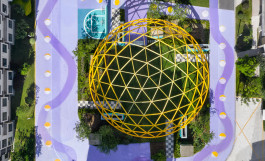
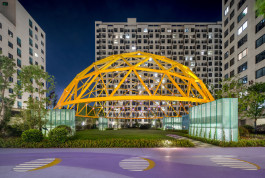
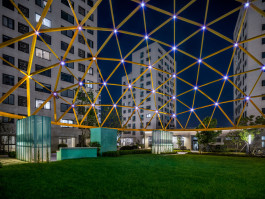
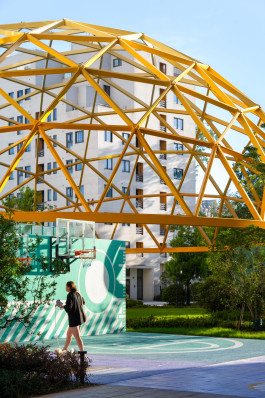
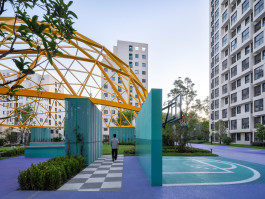
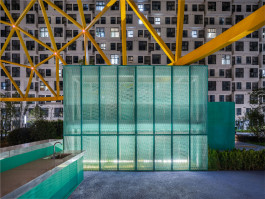
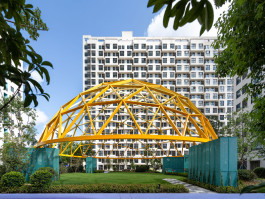
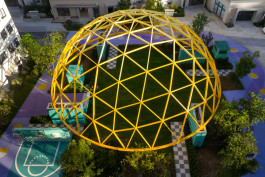
Referencing China’s lunar calendar and the moon as a primary measure of time, the Supermoon is a 26-meter self-supporting geodesic dome resting on four ventilation structures. Inside, each node becomes a point of light, forming a contained celestial field within the city. Residents gather beneath the dome into the evening, extending daytime use into a nighttime activity. In traditional culture, moongazing is a social activity often associated with drinking in the garden; the design supports this function with an outdoor bar.
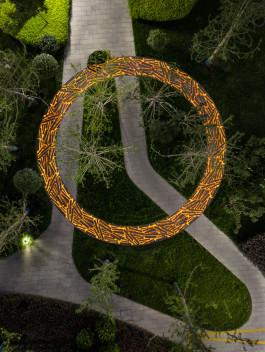
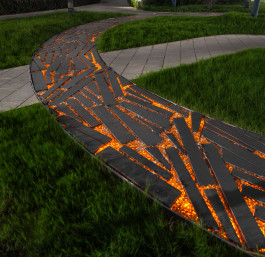
The Earth Core Oasis is a continuous ring of basalt slabs and glass gravel cut through the existing ginkgo grove and entry paths. By day, the basalt reads as a hardened geological flow; by night, light seeps from the joints, producing a restrained, lava-like glow. The ring suggests the earth as an active system rather than a static surface, while also recalling Qi and the meridian systems of traditional Chinese medicine. It frames the ground as a living field of circulation, operating as both diagram and path, linking earth science, bodily perception, and everyday movement.
Â
AWARDS: 2025 Rome Awards
LOCATION: Shanghai
TYPE: Landscape
YEAR: 2024-ongoing
CLIENT: Shanghai Chenglong Real Estate Co., Ltd.
COLLABORATORS: Supermoon Dome Structure – Bespoke